
Every hour your advisors spend in a client meeting generates roughly another hour of administrative follow-up: writing notes, updating CRM records, drafting recap emails, assigning tasks, and logging compliance documentation. Multiply that across 10+ meetings per week per advisor and you begin to see why Schwab's 2025 RIA Benchmarking Study found 51% of firms cite administrative overhead among the top barriers to growth.
The tools to eliminate this bottleneck exist today. What most firms lack is a coherent workflow architecture that ties them together. This post is the technical blueprint. We walk through how to design, build, and deploy an automated pipeline that captures a client meeting, transcribes it, extracts structured data, pushes it into your CRM, generates follow-up communications, and creates a compliance-ready audit trail — with minimal human intervention.
Why This Matters Now: The Research Case
The economics of advisory work are shifting beneath RIAs' feet. Understanding the data makes the case for automation almost self-evident.
Administrative time is your most expensive leak. Kitces Research has documented that advisors spend more than one hour on preparation and follow-up for every hour they sit in a client meeting. That ratio directly constrains client capacity and, ultimately, revenue per professional.
Technology adoption is now a growth predictor, not a cost center. Cerulli's research on technology intensity shows that firms classified as heavy technology users significantly outperform their peers: nearly 30% of high-tech practices achieved above-average growth over a three-year period, compared to only 9% of low-adoption firms. Schwab's 2025 RIA Benchmarking Study reported that 93% of firms with leading-edge technology systems had won clients away from competitors with inferior tech stacks. The inverse is equally stark — 58% of advisors have reported losing new business because their technology wasn't up to par.
CRM is the strategic center of gravity. CRM consistently ranks as the most valuable software category in the T3/Inside Information Advisor Software Survey — ahead of financial planning, portfolio management, and rebalancing tools. Yet CRM only delivers that value when it contains accurate, timely data — and manual entry after every meeting is exactly where data quality goes to die.
The window for competitive advantage is closing. AI meeting assistants are rapidly moving from novelty to necessity. CRM vendors themselves are beginning to embed native transcription and AI note-taking capabilities. Firms that delay implementation risk falling behind not just on productivity, but on compliance quality and client experience delivery.
Architecture Overview: The Five-Stage Pipeline
A fully automated meeting-to-CRM workflow consists of five discrete stages. Each stage can be implemented independently, but the compounding value comes from connecting them into a single pipeline.
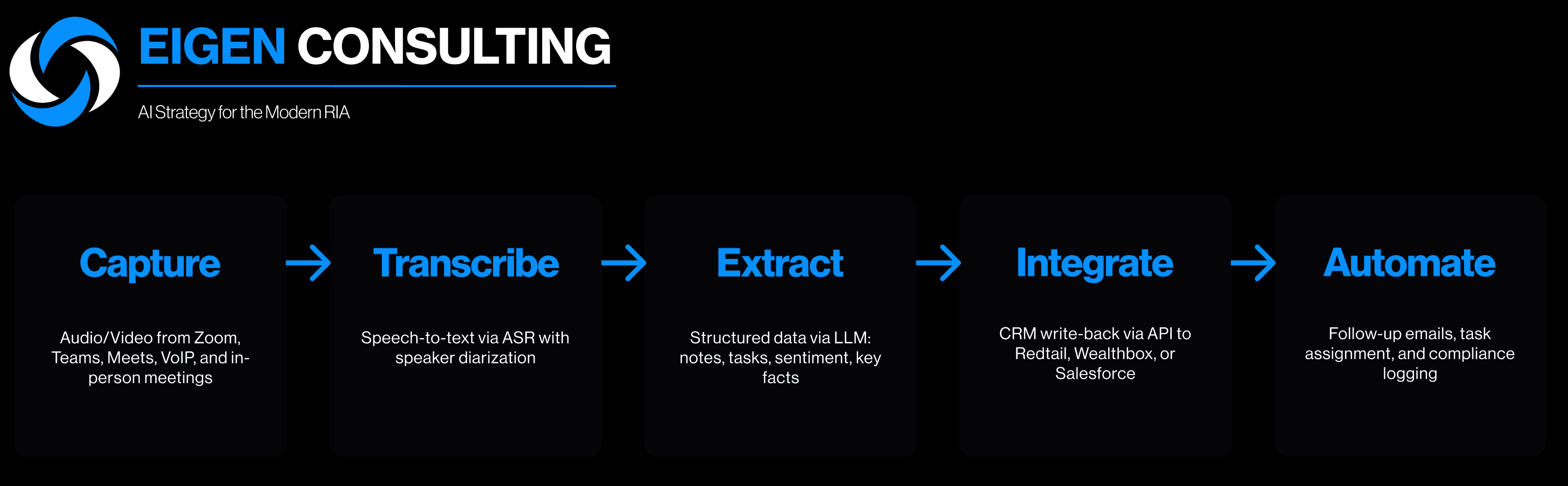
Let's walk through each stage in detail.
Stage 1 — Capture: Getting Audio Into the System
The capture layer needs to handle every meeting modality your firm uses: Zoom, Microsoft Teams, Google Meet, VoIP phone systems, and in-person meetings recorded via mobile device.
Virtual meetings are the simplest case. Most AI meeting tools operate as a "bot participant" that joins the call via calendar integration. When an advisor's calendar event fires, the bot auto-joins, begins recording, and captures the audio stream with speaker separation already handled by the conferencing platform.
In-person and phone meetings are where firms typically leave value on the table. The solution is a mobile capture app (offered by platforms like Zocks, Jump, and others) that records directly from the advisor's device. The critical technical requirement here is client consent management — the system must prompt the advisor to confirm that recording consent has been obtained before capture begins, and log that consent event for compliance.
Implementation considerations:
- Configure calendar-triggered auto-join so advisors don't need to remember to invite the bot.
- Establish a firm-wide consent script and embed it into meeting templates.
- Set retention policies for raw audio files — most compliance frameworks require archival but don't require indefinite storage of recordings.
- Ensure capture works across all platforms your firm uses; cross-channel coverage is a baseline requirement.
Stage 2 — Transcribe: Converting Speech to Text
Modern automatic speech recognition (ASR) engines — the technology layer underlying services like Deepgram, AssemblyAI, OpenAI Whisper, and the engines embedded in advisor-specific platforms — achieve word error rates below 5% in controlled conditions. For financial advisory conversations, accuracy matters enormously: a misheard account number or dollar figure can create downstream compliance risk.
Speaker diarization (identifying who said what) is essential. Without it, you get a wall of text with no attribution. Diarization allows the extraction engine in Stage 3 to distinguish advisor statements from client statements — critical for compliance documentation that must capture what the client communicated versus what the advisor recommended.
Technical decisions at this stage:
- Latency tolerance. Real-time transcription enables live dashboards and in-meeting prompts but adds infrastructure complexity. For most RIA workflows, near-real-time processing (transcript available within 2–5 minutes of meeting end) is sufficient and far simpler to implement.
- Domain vocabulary. Financial services terminology (QSBS, RMD, 529, Roth conversion, cost basis) trips up general-purpose ASR. Purpose-built advisor tools train on financial vocabulary and dramatically reduce errors on domain-specific terms.
- Handling accents and audio quality. Mobile recordings in noisy environments will always produce lower-quality transcripts. Build a human review checkpoint into the workflow for flagged low-confidence segments rather than trying to achieve perfection algorithmically.
Stage 3 — Extract: Turning Transcripts Into Structured Data
This is where the real intelligence lives. A raw transcript is useful for archival, but it's the structured extraction layer that creates operational value. Using large language models (LLMs) — either through an advisor-specific platform or via a custom pipeline built on models like Claude or GPT-4 — the system parses the transcript and produces:
- Meeting summary: A concise 3–5 paragraph narrative of what was discussed, suitable for the CRM note field.
- Action items: Discrete tasks with assignees, deadlines, and context (e.g., "Rebalance taxable account to reduce AAPL concentration — assign to trading desk — complete by end of week").
- Key facts and life events: Client mentioned a new grandchild, upcoming retirement date, property sale, inheritance — facts that belong in the client profile, not buried in a note.
- Sentiment and relationship signals: Did the client express anxiety about market conditions? Enthusiasm about a new planning strategy? These signals help advisors calibrate follow-up tone.
- Compliance flags: Did the advisor discuss a product recommendation? Was suitability addressed? Were risks disclosed? These flags route the note to a compliance review queue when triggered.
Prompt engineering for extraction quality:
The quality of extraction is directly proportional to the specificity of your prompts. A generic "summarize this meeting" instruction produces generic output. Structured prompt templates need to map to your CRM's field schema and your compliance team's review requirements — covering categories like meeting summary, action items with assignees and priorities, client life events, portfolio decisions with rationale, compliance flags with triggering quotes, follow-up email drafts, and suggested agenda for the next meeting.
Test and iterate these prompts against real meeting transcripts (with PII redacted) until extraction accuracy meets your compliance team's standards. Vendor-published benchmarks cite factual data capture accuracy rates of 95% or higher for purpose-built advisor AI tools — meaningfully above general-purpose transcription services on financial-specific terminology. Your mileage will depend on meeting complexity and audio quality.
Stage 4 — Integrate: Writing Data Back to Your CRM
This is the plumbing stage, and it's where many firms stall. Extraction without integration means your team is still copy-pasting AI output into Redtail or Wealthbox manually — a 70% improvement instead of a 95% one.
API-driven CRM integration is the goal. The major RIA CRMs all expose REST APIs:
- Redtail offers an API for creating and updating contacts, notes, activities, and tasks. Its open API and deep integration ecosystem (Orion, Schwab, Fidelity) make it the path of least resistance for most firms.
- Wealthbox provides a clean, modern API with endpoints for contacts, tasks, events, notes, and pipeline opportunities. Wealthbox introduced a native AI meeting notes assistant in 2025, signaling the platform's direction.
- Salesforce Financial Services Cloud offers the most extensible API surface but requires significantly more configuration. Firms using Salesforce typically build integration through middleware (Zapier, Make, or custom Node.js services).
The integration pattern looks like this:
- Extraction engine outputs structured JSON (from Stage 3).
- A middleware service maps JSON fields to CRM object fields (note → CRM note, action item → CRM task, life event → CRM contact custom field).
- The service authenticates against the CRM API and writes the records.
- A confirmation event fires back to the advisor's dashboard or notification system.
Field mapping is where precision matters. Your CRM probably has custom fields for things like risk tolerance, planning stage, family members, and account types. The extraction prompt and the field mapping layer need to align precisely. Build a mapping document that your ops team and your automation engineer both sign off on.
Error handling: API calls fail. Rate limits get hit. Records conflict. Build retry logic, dead-letter queues for failed writes, and daily reconciliation reports that surface any meetings where CRM integration didn't complete successfully.
Stage 5 — Automate: Post-Meeting Workflows
With structured data flowing into your CRM, you can now trigger automated downstream workflows:
Follow-up emails. The extraction engine in Stage 3 already drafted a recap email. Route it to the advisor for a 30-second review and one-click send. Firms using this pattern report that follow-up emails go out within hours of a meeting instead of days — a measurable client experience improvement.
Task orchestration. Action items extracted from the meeting automatically create CRM tasks assigned to the appropriate team member. A Roth conversion discussion creates a task for the planning team. A beneficiary update request creates a task for operations. Use your CRM's native workflow engine (Redtail's workflow automation, Wealthbox's workflow templates, Salesforce Flows) to route tasks by type.
Compliance logging. Every meeting note, along with the original transcript and any compliance flags, gets archived as an immutable record. This satisfies the SEC's books-and-records requirements and gives your CCO a searchable, structured compliance archive instead of a filing cabinet of handwritten notes.
Pre-meeting preparation for the next appointment. The system can generate a pre-meeting brief by querying the CRM for the client's recent notes, open tasks, portfolio changes since last meeting, and any life events logged — giving the advisor a one-page context sheet before their next conversation.
Implementation Roadmap
Don't try to build all five stages simultaneously. A phased approach de-risks the project and delivers value early.
Phase 1 — Capture + Transcribe. Select and deploy an AI meeting tool. Configure calendar integration. Establish consent protocols. Get advisors comfortable with the recording and transcription workflow. Measure transcription accuracy.
Phase 2 — Extract. Configure or build the extraction layer. Develop prompt templates aligned to your firm's CRM fields and compliance requirements. Test extraction accuracy against manual note-taking with a sample of 20–30 real meetings.
Phase 3 — Integrate. Build or configure the CRM API integration. Map extraction fields to CRM objects. Implement error handling and monitoring. Run a parallel period where AI-generated notes are reviewed against manually entered notes before going fully automated.
Phase 4 — Automate. Activate follow-up email drafting, task orchestration, compliance routing, and pre-meeting brief generation. Measure time savings and refine.
Ongoing: Monitor extraction accuracy monthly. Retune prompts as meeting patterns shift (e.g., new planning topics, regulatory changes). Review compliance flag accuracy with your CCO quarterly.
Build vs. Buy: Navigating the Vendor Landscape
RIAs have three paths:
Purpose-built advisor AI platforms (Jump, Zocks, Zeplyn, and others) offer the fastest time-to-value. They come pre-configured with financial vocabulary, CRM integrations for Redtail and Wealthbox, compliance-aware extraction, and consent management. The tradeoff is less customization and vendor lock-in. Pricing ranges from ~$50/user/month (Wealthbox AI Notetaker's introductory rate) to $120+/user/month for top tiers on Jump, Zocks, and Zeplyn. The category is currently seeing price compression — worth checking vendor pages before committing.
CRM-native AI features are emerging rapidly. Wealthbox's AI meeting notes, Altitude's Pathfinder+ co-pilot, and Advisor360°'s generative AI tools represent a convergence where the CRM itself handles transcription and extraction. If your CRM vendor is building this, evaluate whether waiting for their native capability makes more sense than adding a third-party tool.
Custom-built pipelines using ASR APIs (Deepgram, AssemblyAI, Whisper) + LLM APIs (Anthropic Claude, OpenAI) + CRM APIs offer maximum control and customization. This path makes sense for larger firms ($1B+ AUM) with internal engineering resources or a consulting partner, where the firm's workflow complexity exceeds what off-the-shelf tools can accommodate.
The right choice here depends on firm-specific factors — AUM scale, existing stack, compliance posture, internal engineering capacity, vendor risk tolerance. Getting it right is exactly the kind of question Eigen Consulting was built to answer: architecting the pipeline that matches your constraints, whether that means configuring a vendor platform, building custom integrations, or designing a hybrid approach.
Security and Compliance Considerations
Any system that records and processes client conversations must satisfy several non-negotiable requirements:
- Data encryption at rest and in transit. Verify that your vendor or custom system uses AES-256 and TLS 1.2+ at minimum.
- SOC 2 Type II compliance for any third-party vendor handling client data.
- Recording consent documented and archived per state law requirements. Even in one-party consent states, best practice is to notify and obtain affirmative client consent.
- PII handling. Transcripts contain Social Security numbers, account numbers, and health information. Ensure your pipeline either redacts PII before storage or stores it in access-controlled, encrypted vaults.
- Supervisory review. AI-generated notes should be treated as drafts until an advisor reviews and approves them. Build an approval step into the workflow, not as a bottleneck, but as a 30-second quality check.
- Audit trail. Every transformation in the pipeline — raw audio to transcript, transcript to extraction, extraction to CRM write — should be logged with timestamps for regulatory examination readiness.
Measuring ROI
Track these metrics before and after implementation:
- Administrative hours per meeting (target: reduction from 60+ minutes to under 10)
- Time from meeting end to CRM note completion (target: same-hour, ideally within 10 minutes)
- Time from meeting end to client follow-up email (target: under 4 hours)
- CRM data completeness (percentage of meetings with fully populated notes, tasks, and updated contact fields)
- Compliance review efficiency (time per note review for your CCO)
- Client capacity per advisor (the downstream metric that matters most)
Vendor deployments report comparable time savings: Zocks cites 10+ hours saved per advisor per week, and Zeplyn reports 10–12 hours. At revenue-per-professional figures in the high six figures at top-performing RIAs, even a 10% increase in client-facing capacity represents significant top-line impact.
Getting Started
What most firms need isn't another tool — it's an architecture. And that architecture starts with the five stages above. Firms that build them thoughtfully compound the advantage; firms that delay keep paying the Kitces tax — one hour of admin for every hour of client time.
If your firm is evaluating meeting automation, CRM integration, or a broader AI strategy, Eigen Consulting can help you move from evaluation to implementation. We work exclusively with RIAs, and we build systems that your compliance team, your advisors, and your clients will all trust.
Eigen Consulting helps registered investment advisors design and deploy AI-powered operational workflows. We specialize in meeting automation, CRM integration architecture, and compliance-aware AI implementation for firms ranging from $100M to $10B+ in AUM.